
Criminal Cases in the Monroe County Courts
The Iowa District Court for Monroe County is the unified state trial court for local criminal matters. It handles felonies, indictable misdemeanors, simple misdemeanors, traffic cases, and city ordinance matters assigned to its judicial officers. Monroe County sits in Judicial District 8A. Iowa does not split these files between a county criminal clerk and a separate district clerk. The Clerk of District Court is the custodian.
That structure matters when an Albia ordinance charge appears. Iowa cities do not run a separate municipal-court judiciary like some states. A filed city case can become a Monroe County District Court docket. The County Attorney prosecutes state crimes and county ordinance violations, but the prosecutor does not keep the official court file. Ask the clerk for the docket, order, judgment, or certified copy.
The official Monroe County court page shows the local clerk contact and courthouse access details.
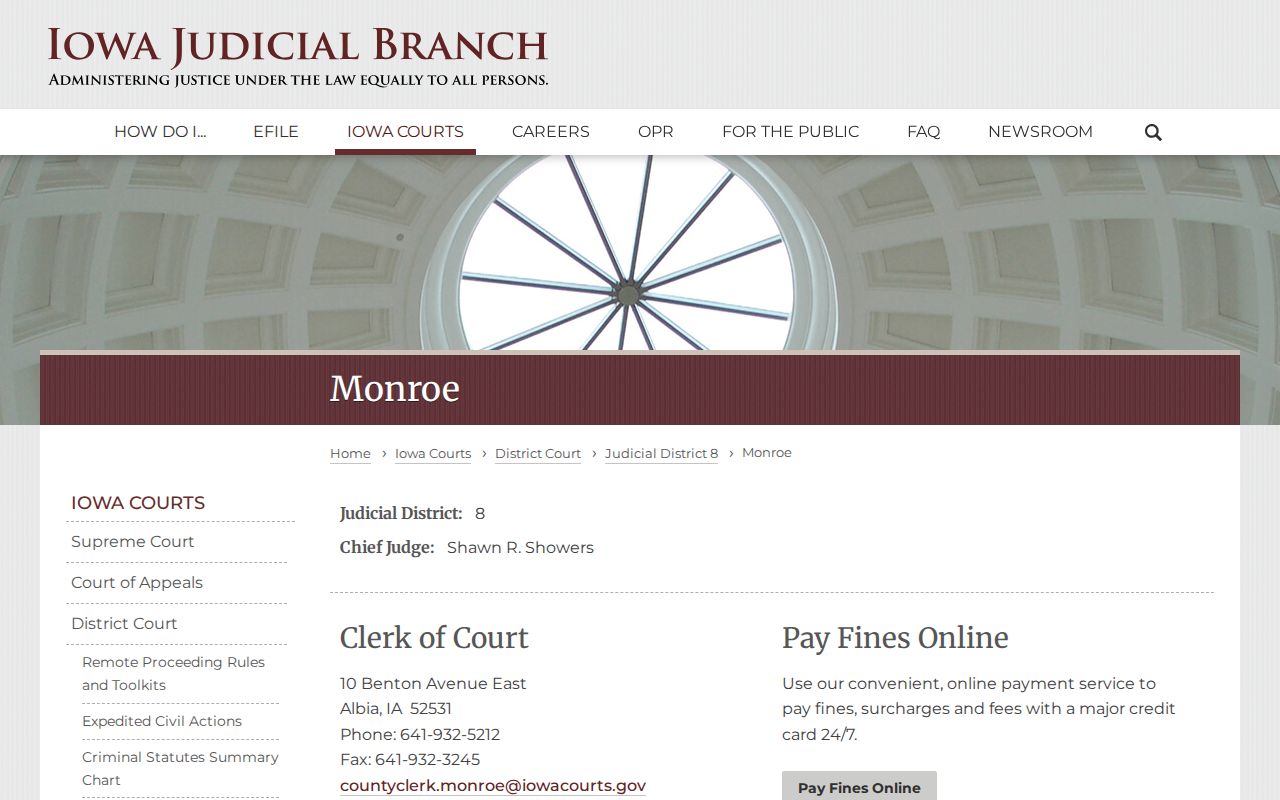
The page anchors a Monroe County criminal case search to the correct state court office rather than a city or prosecutor counter.
Monroe County Criminal Clerk Counter
The clerk works at 10 Benton Avenue East, Albia, IA 52531. Call 641-932-5212 or email countyclerk.monroe@iowacourts.gov. The county posts general courthouse hours that vary by department, so confirm the clerk's current counter hours before travel. Bring the case number when possible. It lets staff identify the correct Monroe County criminal court case without relying on a common name.
Monroe Clerk of Court
10 Benton Avenue East
Albia, IA 52531
641-932-5212
Fax: 641-932-3245
countyclerk.monroe@iowacourts.gov
Public documents filed in Monroe County may be viewed at a courthouse public-access terminal without an online document charge. That does not mean every filing is open or downloadable. Ask the clerk about plain copies, certified copies, archived paper, and any lawful fee before ordering. No Monroe-specific criminal copy schedule is published in the research.
How to Search Case Records
Iowa's official search guidance explains the public index and links to Iowa Courts Online. Public trial-court cases after 1998 are generally indexed, with some earlier electronic files. A case usually appears about one business day after entry in the case-management system. A new citation may take up to fourteen days. Updates occur in real time once the case is in the index.
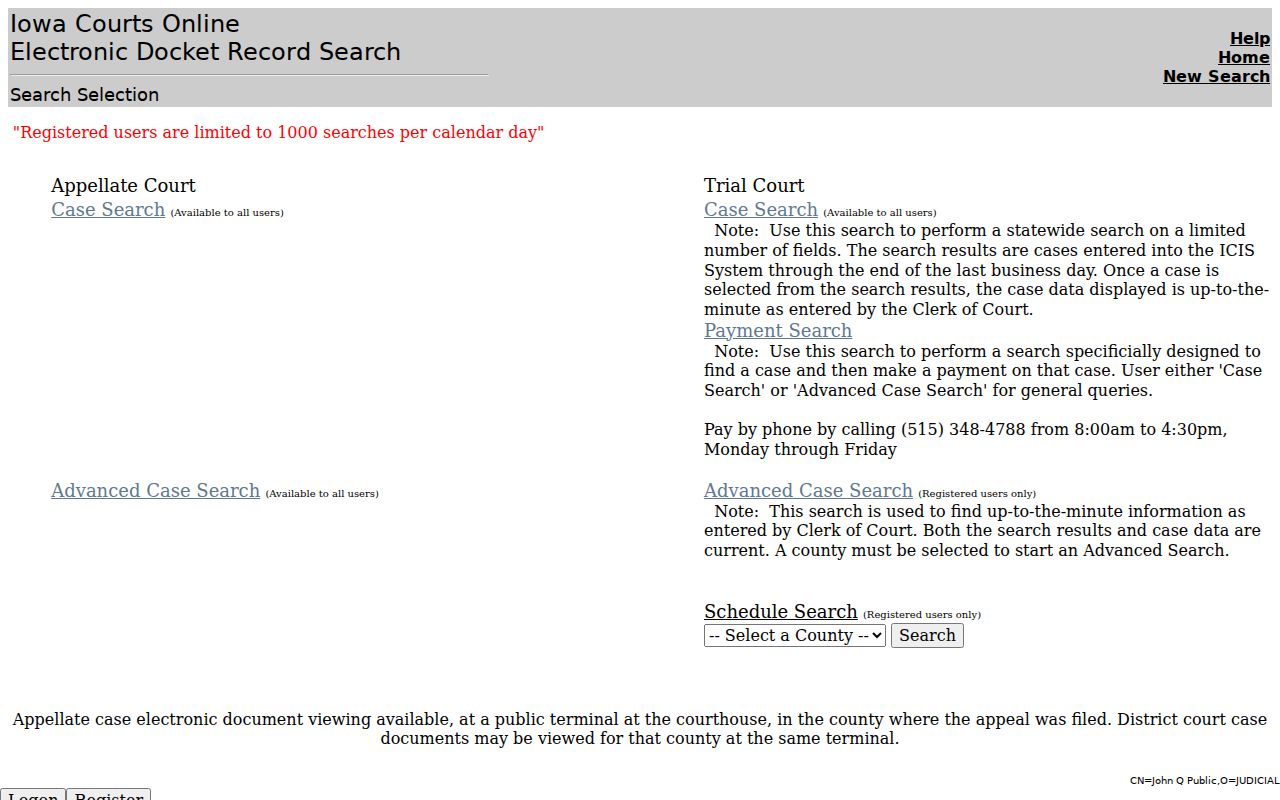
The guidance helps set the right limit: the web index is useful, but the Monroe County clerk holds the official record.
- Open the trial-court search in Iowa Courts Online and choose Monroe in the County field.
- Use the case number when known. Otherwise, enter the legal last name and add first or middle name to narrow the result.
- Choose the relevant criminal or traffic case type. Compare names and case details before deciding that a result belongs to one person.
- Open the Monroe County docket. Read every count, event, status, and disposition instead of relying on the case caption.
- Give the case number to the clerk when requesting a filing, an archived record, or a certified court copy.
The live Iowa Courts Online interface displays the controls used for statewide trial-court searches.
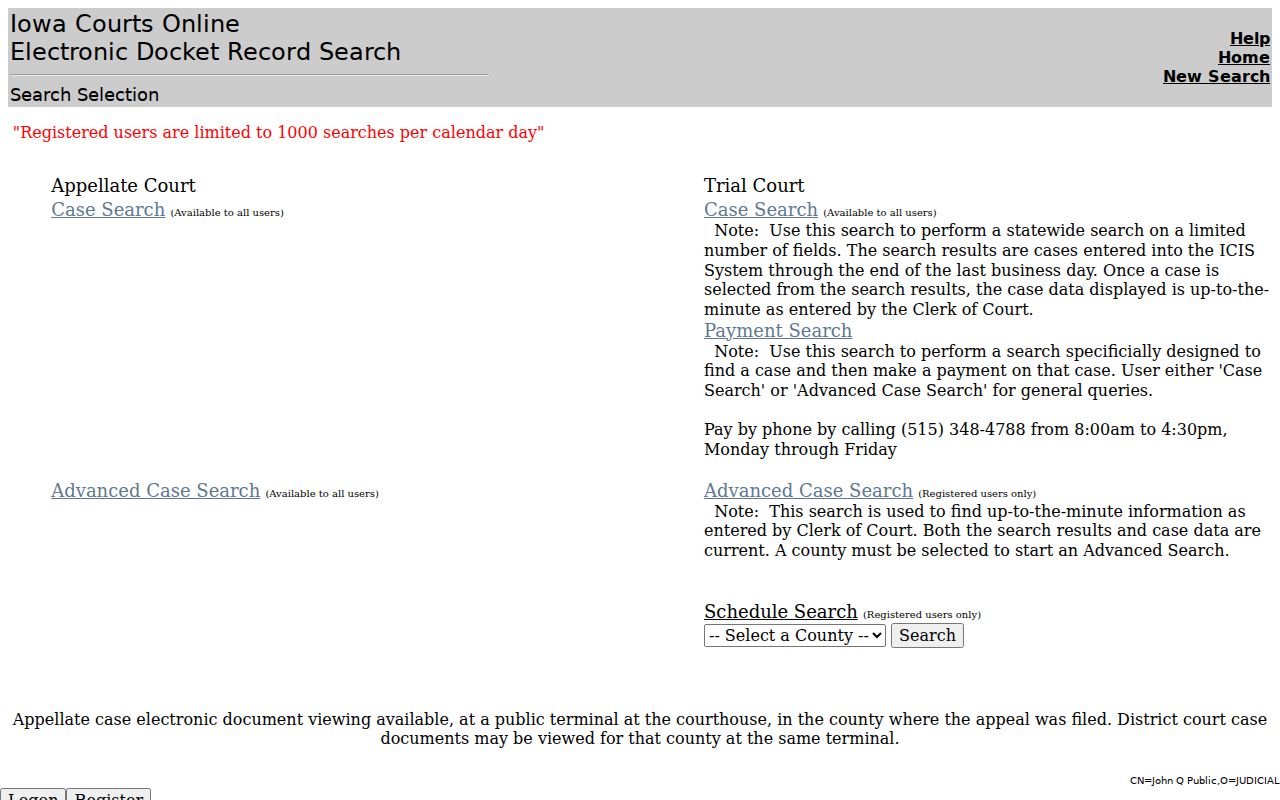
Setting the county to Monroe is one of the best ways to avoid namesake results elsewhere in Iowa.
| Field Label | Type | Required | Notes |
|---|---|---|---|
| Search type | Links or tabs | Yes | Select trial court case search. |
| Case Number | Text | Alternative | Most exact when the identifier is known. |
| Last or Business Name | Text | Alternative | At least two letters; a percent sign works as a wildcard. |
| First and Middle Name | Text | No | Use to narrow common names; omit periods after initials. |
| County | Dropdown | No | Choose Monroe for a local court case search. |
| Case Type | Dropdown | No | Narrow to the relevant criminal or traffic category. |
Monroe County Criminal Search Methods
A party-name search and case-number search answer different needs. A case number points to one file. A name search looks for possible party matches and can return several people. Iowa's Name Search needs at least two letters in the last or firm name. First and middle names are optional. The two-party control can use AND when both names must occur in one case, or OR when either may appear.
DOB Search is stricter. It requires an exact birth date, last name, and first name, with no wildcard in those required fields. Case ID Search requires a county and case type, and it treats zero and the letter O as different characters. If a Monroe County court case does not appear, remove stray spaces, try a former surname, or use fewer name characters. The matter may also be confidential, too old, recently filed, or in another county.
Note: Court technical support helps with the search system, while the Monroe County clerk verifies the facts in a specific case.
What the Case File Shows
A Monroe County criminal court file records the prosecution as it moves through court. The public view may show the case ID, title, county, type, status, filing date, parties, lawyers, charges, hearings, docket events, financial assessments, judicial officer, disposition, and sentence. The docket is a dated register of events. It is not the same as the officer's incident report or the jail's booking sheet.
| Case Number and Court | Identifies the Monroe County file, court, case type, and sequence. |
|---|---|
| Charging Document | Shows the complaint, trial information, or indictment that states the filed accusations. |
| Docket Entries | Lists filings, notices, orders, returns, and other court events by date. |
| Hearing Dates | Shows scheduled or completed appearances when those details are public. |
| Disposition and Judgment | Gives the outcome for each count, such as conviction, dismissal, or acquittal. |
| Sentence and Conditions | Records the court-ordered consequence, financial obligations, and public supervision terms. |
Read each count separately. One count may be amended or dismissed while another ends in conviction. A caption or top-line status can hide that detail. The broader DCI rap sheet links fingerprint-supported arrest cycles to reported court outcomes, while the court docket shows filings and events that may never appear in a public DCI response.
Reading Monroe County Case Outcomes
Iowa court terms can look final when they are not. “Pending” means the court has not entered a terminating outcome. “Disposed” means a terminating court action occurred, but it does not by itself mean guilty. A disposition is the result for a case or count. The judgment follows a guilty plea or finding when the court enters a conviction. An acquittal is a not-guilty determination, and a dismissal ends the charge without a conviction on that count.
- Complaint
- A sworn or filed accusation that begins a case.
- Trial information
- An Iowa prosecutor's formal charging document for an indictable offense.
- Arraignment
- The court stage where the charge and plea are addressed.
- Deferred judgment
- An Iowa process that withholds judgment while the person completes set terms.
- Disposition
- The outcome entered for a case or individual count.
Case-type codes add another layer. FE marks felony, AG aggravated misdemeanor, SR serious misdemeanor, SM simple misdemeanor, OW OWI, and NT nonscheduled traffic in the cited court help. The existence of an SW search-warrant code does not make an unexecuted warrant public.
Stages of a Criminal Case
A Monroe County case begins in court when a charge is filed, not when an officer first investigates an allegation. The prosecutor may use a complaint and later file trial information for an indictable offense. At arraignment, the court addresses the charge and plea. Pretrial filings may cover discovery, release, scheduling, or motions. The matter then reaches a plea, trial, dismissal, or other disposition. A conviction leads to judgment and sentencing.
Case flow: Charges Filed › Arraignment › Pretrial › Plea or Trial › Disposition › Sentencing
Timelines vary by charge, custody, motions, and court scheduling. The Monroe County docket is the sound source for what happened in one case. Do not assign a fixed local time to any stage when the official research gives none. A scheduled event may also be moved, so check the latest entry and confirm with counsel or the clerk when an appearance affects you.
Monroe County Charges and Custody
The Monroe County Attorney works at 201 South Main Street in Albia and prosecutes state criminal and county ordinance cases. That office selects the charges it files. An arrest label can change as facts are reviewed, so it should never substitute for the prosecutor's filed count or the court's final disposition. The office is not a neutral court-record search desk.
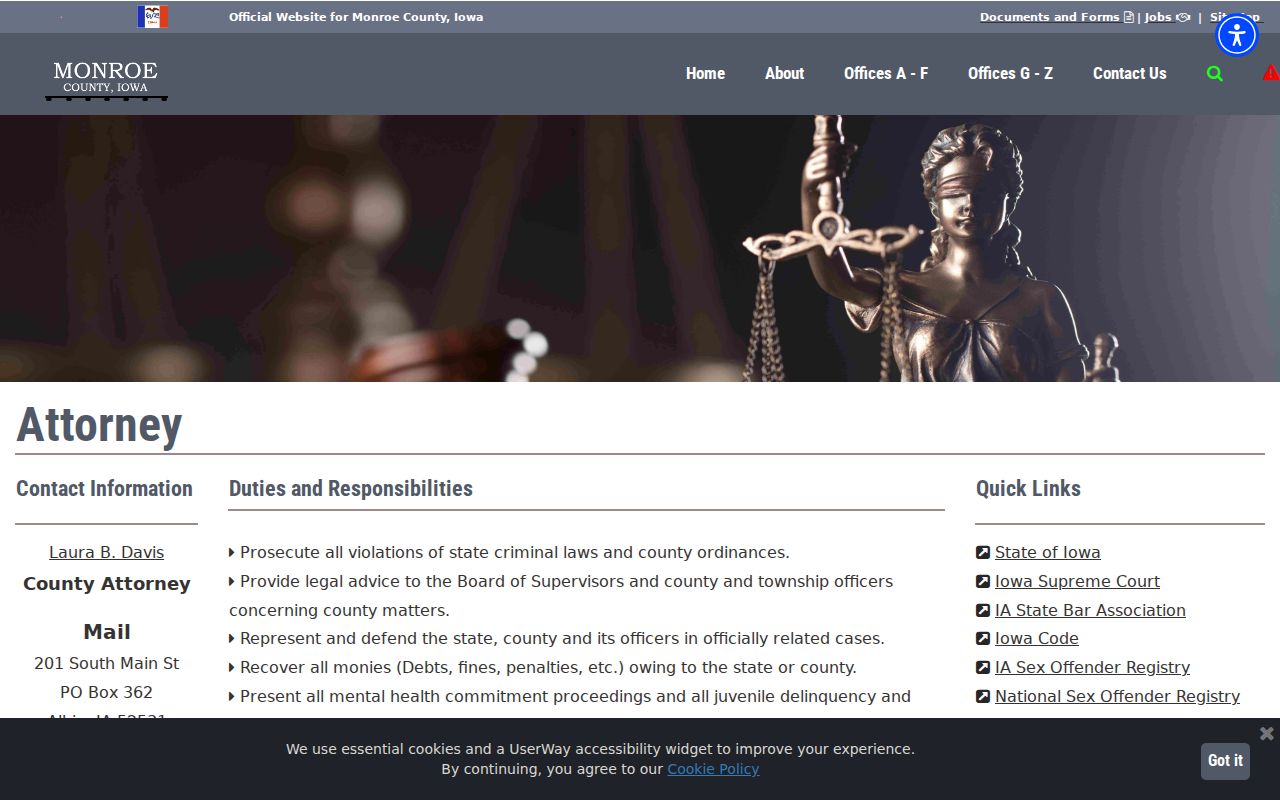
The official office page clarifies the prosecutor's role while leaving court-file requests with the Clerk of District Court.
Iowa indigent defense runs through court appointment and the State Public Defender system. There is no county-published, all-purpose defender office in Monroe County. The Ottumwa office designation is limited in the cited table and should not be treated as a walk-in route for every case. A defendant applies through the Monroe County court. The public docket may name appointed counsel, but private communications and defense work product are not public court records.
Older Monroe County Criminal Files
A missing online result is not proof that no Monroe County case exists. Public trial-court records after 1998 are generally indexed, but older or unconverted matters can remain outside the electronic search. Contact the filing-county clerk for those files. Provide the name used at the time, an estimated year, the charge type if known, and any former surname. A case number is best.
The public terminal can reveal more than a basic home search, including added schedules, advanced search options, exhibit lists, bonds, and returns of service, subject to access rules. Some features may require a paid subscription or clerk access. Request a quote before ordering copies because no Monroe County criminal-copy fee was found. The clerk can also explain whether a record is archived, scanned, sealed, or simply not available online.
Current Iowa court forms include materials used in criminal and expungement matters.
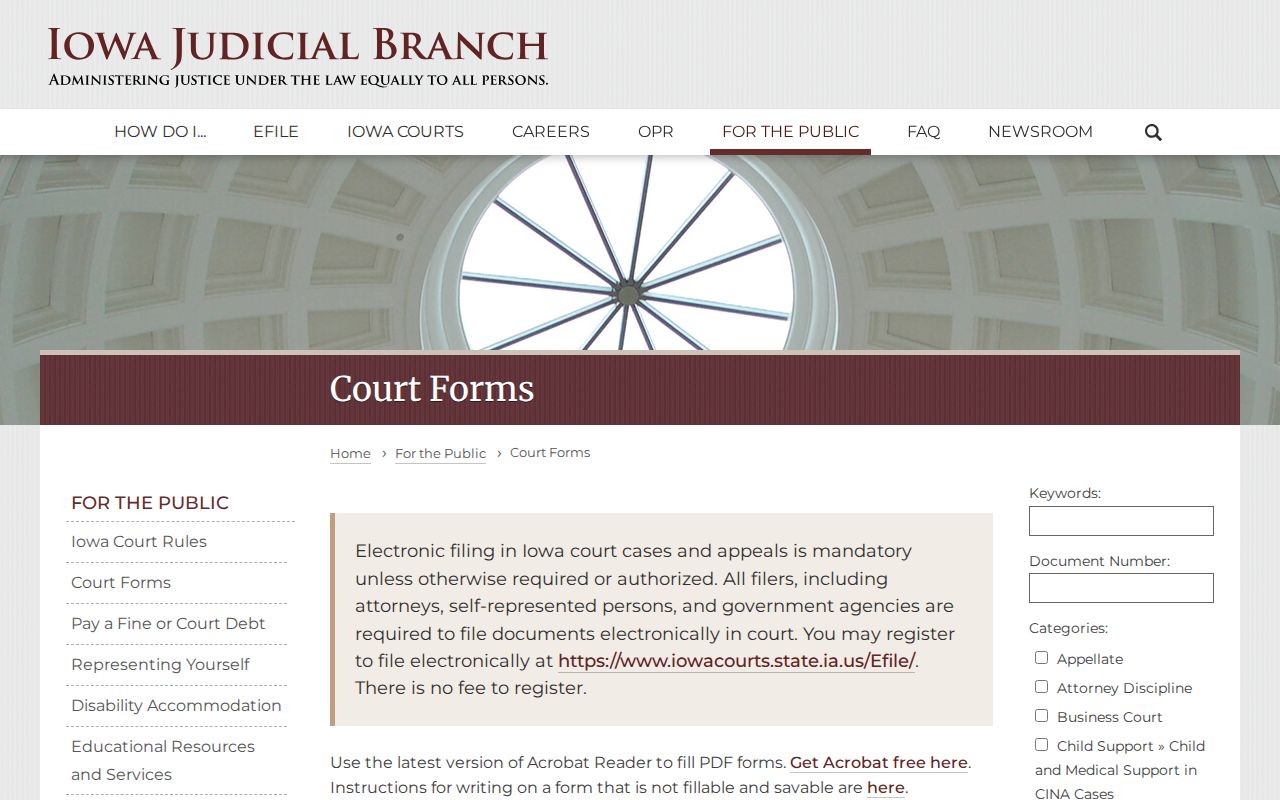
The forms page is useful for current filing materials, but the clerk should confirm the right event, revision, and any required fee.
Access & Restrictions
Iowa Code section 22.2 supports examination and copying of public records unless another law makes them confidential. Court access also follows Iowa court rules and the judicial branch's electronic access system. Public access does not expose every document or identifier. Juvenile court records are restricted under section 232.147, and records may omit protected victim, minor, medical, financial, or identity data.
A docket may remain visible while a filed document is restricted. Some Monroe County case records can become confidential through expungement or another lawful order. The Iowa chapter 901C index is the official statutory starting point for qualifying acquittals, dismissals, deferred judgments, and specified misdemeanors.
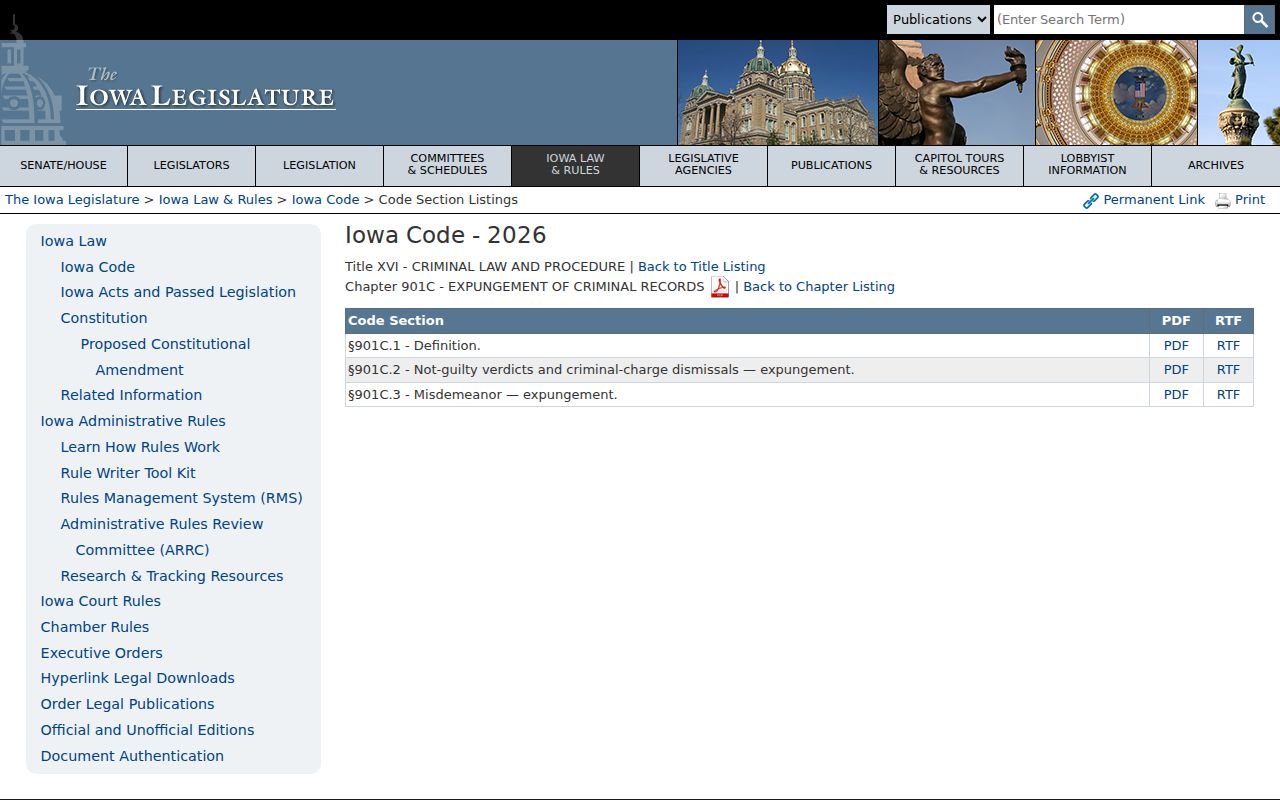
The statute shows why eligibility depends on the exact outcome and offense, not a broad label in a search result.
If a public Monroe County criminal case looks wrong, give the case number and disputed entry to the clerk. The statewide search help desk handles system operation, not certification of case facts. For a record that belongs to you, compare the official docket with the source order before asking for correction.